

Take part in our free prize draw for the chance to be one of our lucky winners, each awarded £1,000.
The draw is open to:
- Serving and retired police officers
- Serving and retired police staff
- Police Community Support Officers
- Special Constables
- And their families – parents, siblings, children, grandchildren
Enter by 30 June 2026 at policemutual.co.uk/q2win or scan the QR code.

T&Cs apply: policemutual.co.uk/q2winterms
UK residents 18+ eligible for Police Mutual products. No purchase necessary.
One entry per person. Draw: 1 July 2026. Prizes delivered within 30 days.
PMGI Limited, trading as Police Mutual is authorised and regulated by the Financial Conduct Authority. Financial Services Register No.114942. Registered in England & Wales No.1073408. Registered office: Brookfield Court, Selby Road, Leeds, LS25 1NB.
Meet Manu – Bedfordshire Police Federation’s first Special Constable Representative
In February 2025, Manu was elected as the Police Federation of Bedfordshire’s first-ever Special Constable representative – a milestone for the force and for the Special Constabulary.
Manu joined Bedfordshire Police following a successful career as a software engineer, having started his professional life in 2007.
Alongside his full-time role, he had always sought opportunities to give something back, previously volunteering with the NHS. An event in his personal life in 2023 ultimately prompted him to apply to join Bedfordshire Police as a Special Constable, with training beginning in 2024.
As he settled into policing, Manu became increasingly aware of concerns among Specials about feeling unheard. Despite issues being raised, there was a perception that they were not always fully understood or addressed. After an input from the Federation, Manu recognised a gap between the Police Federation and the Special Constabulary.

With encouragement from Branch Secretary Bill Rumford and support from his supervisor, Manu submitted his nomination at the end of 2024 and was elected as a Federation Representative in February 2025. Being elected by both Specials and officers outside the Special Constabulary made him feel good and reinforced how needed the role was.
Coming from a non-policing background has presented challenges. Manu represents the whole force, not just Specials, and has had to learn how processes differ across roles. He credits the Federation and fellow representatives for their support, describing the role as a steep but rewarding learning curve.
In addition to encouraging Specials to join the Federation and access support, Manu has joined both the Equality, Diversity and Inclusion group and the Health & Safety group. This has broadened his understanding of policing beyond frontline operational work.
Manu balances his policing duties – typically one 10-hour shift a week at weekends – with Federation responsibilities and a full-time day job. While Federation meetings often take place midweek, flexibility in his corporate role allows him to respond when needed. He says this balance is only possible thanks to the strong support of his family.
Reflecting on policing, Manu says being a Special has exposed him to situations most people never encounter, requiring quick decisions that can have serious consequences. Protecting people and making a difference has been deeply satisfying.
The Federation role has also opened his eyes to another side of policing that many officers don’t fully see or understand, despite how vital it is to officer wellbeing. He says the training provides new perspectives and helps build knowledge – and that’s never a waste.
One of the most rewarding aspects of the Federation role so far has been hearing directly from Specials who now feel confident to raise issues. Manu is keen to see greater consideration of how new initiatives affect Specials, along with more opportunities for them to be involved in specialist units.
Looking ahead, Manu plans to continue developing in his Federation role while also aspiring to move into a specialist policing role in the future.
Supporting our people: Federation Partner Event at Police HQ
The Bedfordshire Police Federation held an event with its Partners with its partners at Police HQ last Wednesday (22nd). The event saw partners such as Philip Williams, Accord Legal Services, Police National Health Scheme showcase their services and talk to staff about its benefits.
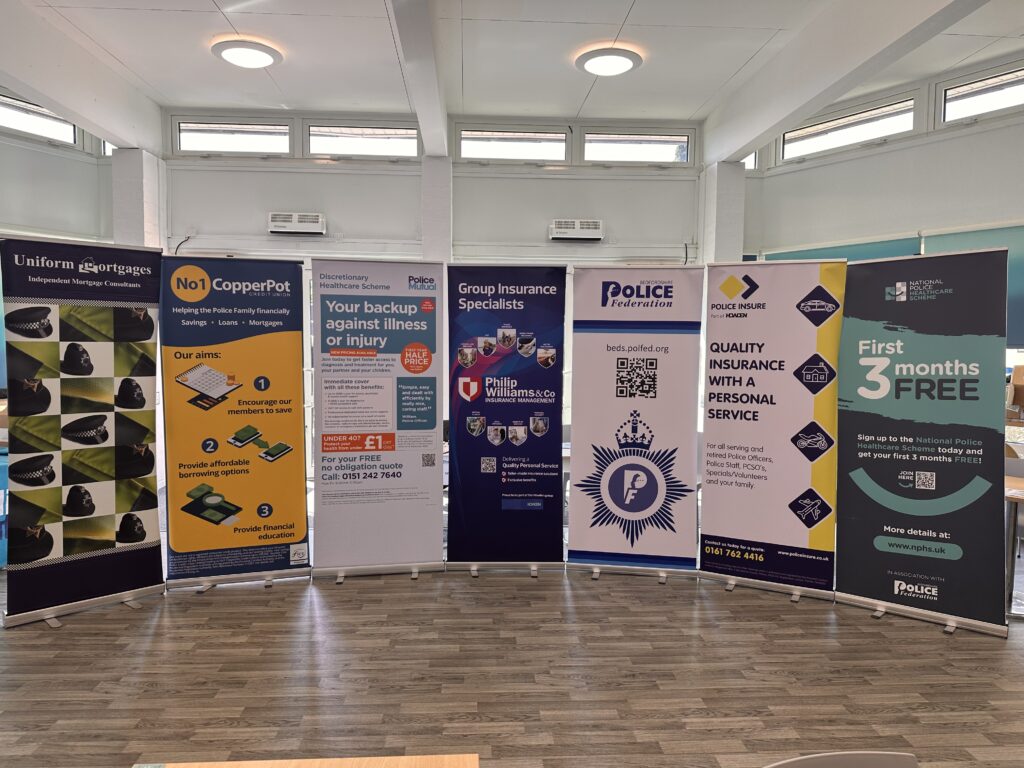
During the day over 150 colleagues engaged with the Federation team and their partners. Enquiries and sign-ups included over 50 free wills, 12 follow up requests for mortgages, sign-ups for No1 CopperPot savings and investments and numerous requests for information about the Police National Healthcare Scheme and Group Life Insurance.
Colleagues also enjoyed a free raffle and a range of giveaways.
The member services are open to all staff, including police staff, specials and police community support officers (PCSO’s).
Federation Chair Stephen Bozward said: “Events like this are a great opportunity for us to connect directly with our members and ensure they’re aware of the support and benefits available to them. The level of engagement we saw demonstrates just how valuable these services are, both professionally and personally. The Federation is here to support colleagues throughout their policing career and beyond.”
The Police Federation represents, supports, and protects police officers
- Represents Bedfordshire Police officers – Supports officers up to the rank of Chief Inspector across Bedfordshire.
- Acts as your local voice – Represents officers’ views at a local level.
- Provides local support and advice – Federation representatives are available across Bedfordshire to help with:
- Support during investigations – Public complaints, misconduct matters, and post incident and use of force investigations.
- Access to legal representation – Ensures members receive legal advice and representation when required.
- Negotiates pay, conditions, and working practices – Including pay and pensions, shifts and hours, and terms and conditions.
- Focuses on officer safety and wellbeing – Raises local concerns about officer safety, equipment and resources, workload, and wellbeing.
- Not a trade union – Police officers cannot strike — the Federation is your statutory staff association.
For further information about what we offer or for advice, please contact the Federation team.
Uniform Mortgages Surgery – April 2026
Secure a Fixed Rate Mortgage
Virtual event on 10th April 2026 at 10:30 – 15:30 With Uniform Mortgages

Uniform Mortgages are running an independent, no obligation mortgage advice clinic to help you secure a competitive rate. We can also secure a rate up to 6 months in advance – so if you have a mortgage now and your fixed rate will be expiring within 6-7 months then please contact us to speak to a Mortgage Advisor today.
To book an appointment please call 01767 316626 or email info@uniformmortgages.co.uk with your requested date, time and best contact number.
If you are interested but unable to attend the clinic you can also arrange an appointment at a mutually agreeable time with the Uniform Mortgages team.
Debt Awareness Week: 16–22 March 2026

We’re proud to support Debt Awareness Week, running from 16–22 March 2026. This national campaign encourages people to seek free, confidential help if they’re struggling with debt, while raising awareness of the barriers that often prevent individuals from reaching out for support.
Throughout the week, our partner PayPlan will be sharing content designed to reassure, educate and empower anyone experiencing financial difficulty. You can find out more about their free debt support at: https://www.payplan.com/
What the Week Covers
- Raising Awareness – Many people delay seeking help due to fear, embarrassment or concerns about their credit score. PayPlan’s content aims to normalise these feelings and make it easier for people to take the first step.
- Accessible support for everyone – PayPlan offers support through phone, live chat, WhatsApp, email and post, along with real‑time translation, BSL interpretation and accessible formats such as large print and Braille. They also hold the BSI Kitemark for Inclusive Service, recognising their commitment to accessibility.
- What to expect from Debt Advice – PayPlan explains what happens during an initial conversation, including a simple budget review and a clear outline of all available options—delivered without pressure and at the individual’s pace.
- Real stories – Throughout the week, PayPlan will share real “Debt Diary” stories showing how reaching out for support has changed people’s lives, helping them move from overwhelm to clarity and confidence.
- Partner impact – The week also highlights the importance of partnerships in helping more people access the support they need. Working together ensures individuals are not left facing debt alone.
Motor Source Group Offers – March 2026
The new 26 reg plate has arrived! Fancy owning one for less? Motor Source Group has you covered with some cracking deals this March, including the Chery Tiggo 7, one of the best-value SUVs on the market, saving you £5,038 or the new Toyota C-HR+, with savings of £7,827.
With access to over 28 leading brands, exclusive new car discounts, mainland UK delivery and part exchange welcome, our team is here and ready to help you make the right decision on your next car.

Uniform Mortgages Surgery – March 2026
Zero Charge For Mortgage Advice

Virtual event on 6th March 2026 at 10:30 – 15:30 With Uniform Mortgages
Uniform Mortgages are running an independent, no obligation mortgage advice clinic to help you secure a competitive rate. We can also secure a rate up to 6 months in advance – so if you have a mortgage now and your fixed rate will be expiring within 6-7 months then please contact us to speak to a Mortgage Advisor today with your requested date, time and best contact number.
If you are interested but unable to attend you can also arrange an appointment at a mutually agreeable time with the Uniform Mortgages team.
To book an appointment please call 01767 316626 or email info@uniformmortgages.co.uk with your requested date, time and best contact number.
If you are interested but unable to attend the clinic you can also arrange an appointment at a mutually agreeable time with the Uniform Mortgages team.
Rising use of bailiffs

Published in partnership with PayPlan
The use of bailiffs has increased in recent years. Enforcement action can be distressing, and support for dealing with bailiffs can be difficult to find. Why has this rise occurred, and what changes are being proposed?
Increased bailiff action
Council tax arrears are now the fastest-growing form of debt. To give an idea of the scale, 44% of people who contact us need help with priority arrears, which includes council tax.1
Reasons why people fall behind
People can fall into arrears for many reasons, often through no fault of their own, including:
- Job loss or reduced income
- Ill health
- Changes in personal or family circumstances
Why council tax specifically?
Under the current system, council tax debt can escalate very quickly. After a missed payment, a council may request the full year’s bill within a short timeframe, depending on local authority processes.
If this isn’t paid within a week, the council can apply for a liability order, which allows them to pass the debt to enforcement agents (bailiffs).
Investigations into council tax debt
A BBC investigation found that households owe £6.6bn in council tax to local authorities in England.2
This sharp rise in arrears has led campaigners and charities to call for changes to the recovery system, with a focus on earlier support and affordability, rather than relying on bailiff action as a default.
Proposed changes
Suggestions for reform include:
- Slowing down the collection process
- Taking a person’s circumstances into account earlier
- Limiting the additional costs and fees that can be added
There are also proposals to mirror the government’s ‘Tell Us Once’ service – which automatically notifies multiple departments automatically after someone passes away – to make changes to council tax status simpler and more joined up when circumstances change.
The overall aim is to make the system easier to navigate and to give people clearer, more flexible ways to repay arrears.
Routes to change
The Enforcement Conduct Board (ECB) has been created to provide independent oversight of the debt enforcement sector in England and Wales.3
Its aims include:
- Improving how enforcement firms and agents identify and support vulnerable people
- Increasing the use of sustainable repayment arrangements where people can’t pay in full straight away
From 1 January 2025, the ECB started handling new complaints about the conduct of enforcement agents or firms where individuals feel their complaint hasn’t been dealt with fairly or in a timely way by the enforcement company itself.
This is intended to strengthen accountability and improve protections, particularly for vulnerable people.
Why the ECB exists
The ECB works to identify practices that may cause harm, especially to vulnerable clients.
They consider a range of vulnerability indicators, including:4
- Mental health conditions
- Severe or long-term illness
- Financial hardship
- Domestic or economic abuse
Finding support if you’re facing bailiff action
If you’re facing bailiff action, you don’t have to deal with it alone. Support is available, and it’s often possible to explore options before things escalate further.
Our advisors can talk you through what support may be available to you and help you understand your options.
If you are struggling with debts call us on 0800 072 1206. We’re open from 8am – 8pm Monday to Friday and 9am – 3pm on Saturdays.
Alternatively, you can visit our www.payplan.com/police to speak to us via live chat or more information
[1] The growing problem of local authority bailiff use – Money and Mental Health Policy Institute
[2] Council tax: Households owe billions ahead of bill rise – BBC News
[3] Fairer system for debt collection to boost protections for financially vulnerable – GOV.UK
[4] Why Enforcement Needs to Embrace Shared Vulnerability Data
The difference between priority and non-priority debts (and why it matters)
Published in partnership with PayPlan
With so many types of debt, it can be hard to know which should be paid first. Understanding the difference between priority and non-priority debts helps you budget more effectively and stay in control of your money.
What are priority debts?
Priority debts are those that must be paid to avoid serious consequences – from losing access to essential services to facing legal action.
That’s why these debts are called priority debts – they should always be paid first over other debts.
What happens if I don’t pay priority debts?
The consequences depend on the type of debt and can include:
- Bailiff action – for example, if you don’t pay your council tax, gas and electricity bills.
- Disconnection of utilities – if gas or electricity bills remain unpaid.
- Losing your home – in the most serious cases, missed rent, mortgage or secured loan payments can result in eviction or repossession.
- Repossession of a vehicle on finance – if you fall into arrears.
What types of priority debts are there?
Common priority debts include:
- Mortgage or rent arrears
- Council tax arrears
- Gas and electricity arrears
- HMRC
- TV licence fines
- Court fines or child maintenance
- Hire Purchase (HP), Personal Contract Purchase (PCP) or Lease Agreement arrears
What are non-priority debts?
Non-priority debts are still important – but the consequences of missed payments are generally less severe. They don’t usually put your home or essential services at immediate risk.
What happens if I don’t pay non-priority debts?
If you fall behind on these, you could face:
- County Court Judgments (CCJs) – creditors may take legal action to recover what you owe.
- Debt collection – your debt could be sold to another company that pursues repayment.
- Damage to your credit file – missed payments can lead to default notices and harm your credit rating.
What types of debt are non-priority?
Common non-priority debts include:
- Credit cards
- Personal loans
- Store cards or catalogue debts
- Overdrafts
What this means for your budget
When managing your household budget, always make sure priority debts are covered first – they carry the most serious consequences if left unpaid.
Once those are managed, focus on non-priority debts. Keeping up with minimum payments, where possible, can help prevent defaults while you explore longer-term solutions.
We’re here to help
If you are struggling with debts call us on 0800 072 1206. We’re open from 8am – 8pm Monday to Friday and 9am – 3pm on Saturdays.
Alternatively, you can visit our www.payplan.com/police to speak to us via live chat or more information.