
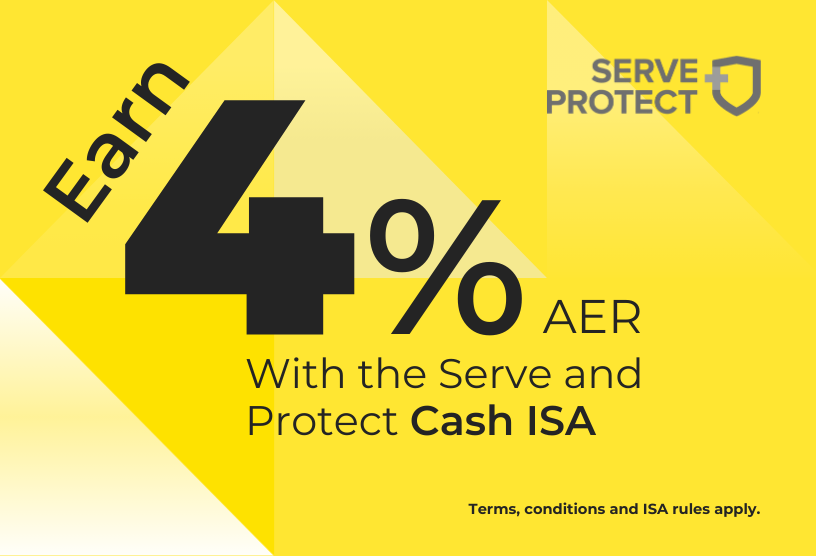
Serve and Protect Credit Union have launched a Fixed Cash ISA for the 2025/26 tax year giving employees within the Police, Prison, Military, Fire and Health Services the opportunity to earn a guaranteed tax-free return of 4% AER (Annual Equivalent Rate).
- Minimum effort, maximum return: Start depositing from as little as £5 and up to a maximum of £20,000 for the 2025/26 tax year.
- Attractive returns: Enjoy a guaranteed tax-free return of 4% AER, allowing you to earn more from your savings effortlessly.
- Safety assured: Rest easy knowing your savings are protected up to £85,000 by the FSCS (Financial Services Compensation Scheme).
For people, not profit.
Serve and Protect Credit Union prides itself on being more than just a financial institution. As a not-for-profit, by opening an account, you can make a real impact to the lives of those who serve and protect our nation. Your support provides crucial funds to help fellow colleagues seeking affordable credit.
For more information or to apply please visit: https://serveandprotectcu.co.uk/save/cash-isa/
Keep on top of your pensions – find your missing pension pots with PayPlan
With the availability of private pensions, along with workplace pensions, it can be hard to keep track of the pensions in your name, especially if you’ve moved jobs multiple times.
If you’ve worked in any roles where you earned over £10,000 per year, were over 22 years old, were classed as a worker, and lived in the UK, then you’ll most likely have been enrolled in a workplace pension scheme.
With planning for the future and retirement at the forefront of many people’s minds, finding all your pension pots will help you to understand the approximate value of your retirement fund and can help you make educated decisions about the additional amount you need to save.
How can I find my lost pension pots?
Check through your paperwork and emails
Have a look through your letters and emails, most pension providers send a yearly statement that shows the value of your plan and estimated retirement value. You may have employment paperwork detailing your pension scheme too. If you paid into a private pension, you should be able to see your provider name on previous bank statements.
Reach out to your previous employers
If you’re struggling to find any statements, you can reach out to your previous employers to ask for details of the pension scheme you were enrolled in. To save time, make sure you have your employment details ready, including the dates you worked for the business and your National Insurance number.
Contact your pension provider
If you know your pension provider but don’t have any details of your plan, you can contact them directly to get access to your account. You’ll most likely need to provide them with two forms of ID, your date of birth and an idea of when you think you enrolled in the plan for them to be able to access your details.
Use the Pension Tracing Service
The Pension Tracing Service will help you find pension contact details on GOV.UK or you can contact them by phone or post.
What are the next steps after finding my pension pots?
Once you’ve located your pension pots, you’ll have a much better idea of how much is currently in your retirement fund and what your potential retirement fund will be.
We recommend ensuring all your contact details are up-to-date with each provider and storing the details for each one safely and securely for future reference.
You may choose to consolidate your pensions. We recommend speaking to a financial advisor to make an informed decision about what would be best for you
What you can do next
While thinking about your pension pots and retirement, you may be worried about debts and their impact on your future. Our team is available to offer free debt advice
If you are struggling with debts call us on 0800 072 1206. We’re open from 8am – 8pm Monday to Friday and 9am – 3pm on Saturdays.
Alternatively, you can visit our www.payplan.com/police to speak to us via live chat or for more information.
Tips for teaching children about money: building the foundation for financial success with PayPlan
Helping children learn about money is one of the most valuable life skills you can give them. Understanding how to manage money from an early age can set them up for a strong start in life, building habits that lead to financial stability in the future.
Below we’re sharing some practical tips you can use when teaching your children about money:
1. Start early
It’s never too early to start! Even young children can grasp basic concepts like saving, spending, and sharing. Use play money, toys, or games to introduce them to these ideas.
2. Set a good example
Children learn by watching and getting involved. Let them see you handling money. If you budget, save and make wise spending choices, they’re likely to follow in your footsteps.
3. Use pocket money to teach budgeting skills
Giving your children a small amount of pocket money can teach them the skills to manage it. Teach them to divide it into categories such as saving, spending and giving. By encouraging them to save a portion for future occasions, you’ll be setting a good foundation.
4. Make saving fun
Set a savings goal and reward your children for reaching milestones. You could use saving envelopes where they can tick off once they’ve filled each envelope. You could also open a savings account for them and, if there’s an app available, check it together to track their progress and celebrate growth.
5. Talk about needs vs. wants
Explore the difference between needs (things such as food, housing and clothes) and wants (things such as toys, games and days out). Learning how to prioritise needs before wants is a vital life skill and will help them make better financial decisions as they grow.
6. Teach the value of earning
Encouraging your children to take on small jobs to earn money, such as household chores or helping family and friends, is a great way to teach responsibility and the link between effort and reward.
7. Talk about money
Let your children ask you questions about money and offer simple answers using the opportunity to teach where appropriate. Money can be a cause of stress for many, especially if you’re struggling with debt, and talking about it can be hard. However, children learn very little about money during school, so it’s important to equip them with the skills they need at home. When they’re old enough to understand, opening up about debt and how hard some people struggle can be beneficial. By helping children as they get older learn how to manage credit and how easy it can be to fall into debt, if they take out more credit than they can repay. You can teach them how easy it can be to fall into financial trouble, especially when they take on more credit than they can repay. As they grow older, showing them how to manage credit responsibly helps them make smarter financial choices and avoid common pitfalls.
Teaching children the basics of money management early on equips children with a skill that will serve them throughout their lifetime and encourage them to pass those skills on to the next generation.
What you can do next
If you are struggling with debts call us on 0800 072 1206. We’re open from 8am – 8pm Monday to Friday and 9am – 3pm on Saturdays.
Alternatively, you can visit our www.payplan.com/police to speak to us via live chat or for more information.
Police Insure

New from Police Insure
GP24 New App Available Now
There has been a major update for the GP24 App and Digital Booking System available through your Group Insurance Scheme.
The new app will allow you to choose an appointment time to suit your needs and integrate with any other HealthHero services in your scheme.
Please take the time to download the App by visiting https://philipwilliams.gp24.co/or scan the QR Code using access code GP24

How to save the web app
On first use, click Reset Password to create an account
and Use code BD25 to register
iOS Device
In the Safari web browser navigate to the web app link above. Then click the icon shown left
and select ‘Add to Home Screen’ and then ‘Add’.
Android Device
In the web browser navigate to the web app link above. Then click the icon shown left and select ‘Add to Home Screen’.
Laptop/Desktop – PC
Right click with the mouse to display the menu and select ‘Create Shortcut’.
How to check if you could pay less council tax
If you’re currently paying council tax for your home in England, depending on your circumstances you may be able to receive a discount or not pay it at all.
You may be able to get:
- A discount, for example, for single-person occupancy or for an empty property
- Council Tax Reduction (CTR) if you’re a low-income household
- Other reductions dependent on your circumstances
If you think you might be eligible for a discount or a reduction, it won’t happen automatically, so you’ll need to make sure you apply. It would be a good idea to also check you’re on the correct council tax banding which you can do here. You can challenge your banding if you think it’s incorrect.
Guidance is different if you live in Scotland or Wales – find out more here:
- Scotland Discounts, exemptions and reductions – mygov.scot
- Wales Council Tax discounts and reduction | GOV.WALES
Council Tax discounts
If you’re the only adult in the household, you can receive a 25% discount on your council tax bill.
Some people in a household aren’t counted for in the council tax bill, including anyone under 18, students, people with learning difficulties or anyone who has a severe mental impairment. If everyone in the household meets this criteria, there’ll still be a council tax bill, but it will have a 50% discount. You don’t pay council tax if everyone in your household is a student or severely mentally impaired.
If you or your partner are receiving the ‘guaranteed’ part of Pension Credit, you may be eligible for a full reduction on your council tax bill, up to 100%.
A ‘second adult rebate’ discount may be available if an adult you live with is on a low income or receiving certain benefits.
If someone moves out of your household and this entitles you to a discount, you need to tell the council. Even if you tell the council after the moving out date, you’re entitled to the discount from the moving date.
If you own another home
Your local council may give you a discount if you have another home that you don’t live in, such as one that needs repair work or is empty. If your property is unoccupied and undergoing major repair work or structural alterations to make it habitable, then you may be exempt from paying council tax for up to 12 months.
If you have a holiday or second home, you may qualify for a 50% discount if it’s owned by someone who can’t live there due to needing to be in another location for work.
If you have an annexe connected to your home, you’ll receive a 50% discount if it’s used by people who live in the main household or immediate family members. If you have a dependant family member who lives there, you don’t need to pay council tax on the property. They must be over 65 years old or have a physical or mental disability. If the annexe is empty, you don’t need to pay council tax for it.
If you live with a disabled individual
If you or someone you live with is disabled, your council will charge you the rate for the next lowest council tax band. For example, if your house is in band D, you will be charged for band C instead.
You must evidence that your home is adapted for a disabled individual and that the individual lives there. For example, there is an extra bathroom or kitchen to meet their needs, and there is enough space for a wheelchair.
Council Tax Reduction (CTR)
Low-income households may be able to receive a council tax reduction. If you receive benefits or have other people living in the home with you, this may affect the amount your council tax is reduced by.
You’ll have to submit details of your income and circumstances to the council so that they can evaluate if you qualify for CTR. If you’re awarded it, your bill will be reduced accordingly.
Discretionary Reduction
If you’re really struggling to pay your council tax bill and don’t qualify for any of the reductions, you can contact your local council directly about a ‘discretionary reduction’. They will ask for evidence of your circumstances to show that you’re suffering financial hardship and can’t afford your bill, then review on a case-by-case basis.
How you pay can reduce the monthly amount
The total year’s amount will stay the same, but you can choose to split your bill over 12 months instead of the usual ten, which will reduce your monthly cost. If you contact your local council, they will alter your payment schedule. Alternatively, you can choose to pay in full.
What you can do next
If you are struggling with debts call us on 0800 072 1206. We’re open from 8am – 8pm Monday to Friday and 9am – 3pm on Saturdays.
Alternatively, you can visit our www.payplan.com/police to speak to us via live chat or for more information.
Everything you need to know about The Winter Fuel Payment
The Winter Fuel Payment is an annual payment from the government to help eligible people with their heating costs during the colder months. It’s usually between £100 and £300 depending on your circumstances.
If you’re eligible, you’ll normally receive your payment automatically. It’s tax-free and won’t affect any benefits you receive.
Who is eligible?
If you were born before 23 September 1958, you can get a Winter Fuel Payment for Winter 2024 to 2025.
You must also live in England or Wales and receive one of the following:
- Pension Credit
- Universal Credit
- Income-related Employment and Support Allowance (ESA)
- Income-based Jobseeker’s Allowance (JSA)
- Income Support
If you live in Scotland, you might qualify for an annual Pension Age Winter Heating Payment instead.
How much will you receive and when?
In October or November, if eligible, you’ll receive a letter telling you how much Winter Fuel Payment you’ll receive. If you think you’re eligible but don’t receive a letter, check if you need to make a claim.
The amount you receive is based on your birth date and circumstances between 16 and 22 September 2024. This is called the ‘qualifying week’.
Payments are automatically received in November or December. You’ll receive a letter explaining how much you’ll receive and what bank account it will be paid into—usually the same account as your benefits or Pension Credit.
If you live alone
You’ll get either:
- £200 if you were born between 23 September 1944 and 22 September 1958
- £300 if you were born before 23 September 1944
If you live with someone
If you and your partner jointly claim any of the benefits, one of you will get a payment of either:
- £200 if both of you were born between 23 September 1944 and 22 September 1958
- £300 if one or both of you were born before 23 September 1944
It’ll be paid into the bank account your benefits are usually paid into.
If you live in a care home
If you’re eligible you’ll get either:
- £100 if you were born between 23 September 1944 and 22 September 1958
- £150 if you were born before 23 September 1944
Other help with heating bills
You could also get:
- a Cold Weather Payment – if the weather drops to zero degrees Celsius or below for seven days in a row and you receive certain benefits you may be eligible.
- the Warm Home Discount – this is a £150 discount on your bills if you receive Pension Credit or live in a low-income household
- help from the Household Support Fund, if you’re eligible under your local council’s rules – check on your local council’s website
What you can do next
If you are struggling with debts call us on 0800 072 1206. We’re open from 8am – 8pm Monday to Friday and 9am – 3pm on Saturdays.
Alternatively, you can visit our www.payplan.com/police to speak to us via live chat or for more information.
Support with raising children
Raising children is one of the most rewarding experiences life can offer. However, it can be surrounded by a fair share of worries, particularly when it comes to your finances. From milk to nappies, childcare to clothing, the costs soon add up.
The average amount of money spent on raising a child from birth to 18 in the UK – including housing and childcare costs – is £223,256, according to the latest research from investment platform Moneyfarm. That works out at about £12,400 a year, or £1,030 a month. (The Times Website)
For many prospective and new parents, these financial concerns can be overwhelming, which is why we have put together a list of resources and benefits that may be available to help ease the burden depending on your circumstances.
Help with childcare costs available
- Sure Start Maternity Grant – You could get a one-off payment of £500 to help towards the costs of having a child. You usually qualify for the grant if you’re expecting your first child, or you’re expecting a multiple birth (such as twins) and have children already and you or your partner already get certain benefits. The grant must be claimed within 11 weeks of the baby’s due date or within 6 months after the baby has been born. The grant does not need to be paid back and it does not affect your other benefits or tax credits. If you live in Scotland, you cannot get a Sure Start Maternity Grant, you can apply for a Pregnancy and Baby Payment instead. To find out more about the Sure Start Maternity Grant click here.
- Healthy Start Vouchers – If you’re more than 10 weeks pregnant or have a child under 4, you may be able to get help to buy healthy food and milk. Click here to check the eligibility criteria.
The vouchers can be used for;
- Plain liquid cow’s milk
- Fresh, frozen, and tinned fruit and vegetables
- Fresh, dried, and tinned pulses
- Infant formula milk based on cow’s milk
- Child Benefit – Child Benefit is available if you are responsible for raising a child under 16, or under 20 if they remain in approved education or training. Payments are made every 4 weeks, typically on a Monday or Tuesday. There are two rates: £25.60 per week for the eldest or only child, and £16.95 per week for each additional child. You can claim Child Benefit 48 hours after registering your child’s birth or once a child starts living with you. Claims can be backdated for up to 3 months. If either you or your partner has an ‘adjusted net income’ over £60,000 a year, you may have to pay the High Income Child Benefit Charge. Click here to check the eligibility criteria.
- Tax Free Childcare – You can receive up to £500 every 3 months (up to £2,000 a year) per child to help with childcare costs. For a disabled child, this amount increases to £1,000 every 3 months (up to £4,000 a year). To access this support, you need to set up an online childcare account for your child. For every £8 you deposit into the account, the government will contribute £2, which can be used to pay for childminders, nurseries, after-school clubs, nannies, and play schemes. Note that you cannot receive Tax-Free Childcare simultaneously with Working Tax Credit, Child Tax Credit, Universal Credit, or childcare vouchers. Click here to check the eligibility criteria.
- Universal Credit Childcare Support – If you qualify for Universal Credit, you might be able to reclaim up to 85% of your childcare costs while working. This could amount to up to £951 per month for one child or £1,630 for two or more children. You need to pay for your childcare costs upfront, report them to Universal Credit, and then receive a reimbursement for a portion of the expenses. Find out more here.
- 15 & 30 Hours Free Childcare – In England, working parents or those receiving government support can access 15 hours of childcare per week for their 2-year-olds. The same eligibility extends to parents of 3 and 4-year-olds, who can receive 30 hours of childcare per week. Starting in September 2024, the government will provide 15 hours of funded childcare to all children from 9 months old. By September 2025, working parents of children under five will be entitled to 30 hours of government-funded childcare per week. Find out more here.
- Free school meals – All children will be able to get free school meals if they’re in a government-funded school and in reception class, year 1 or year 2. After this age, you may get free school meals if you receive certain benefits. Find out if you are eligible here.
- Holiday activities and food programme – If you get access to free school meals you quality for free activities and healthy food for your children in the Easter, Summer and Christmas school holidays. Further information can be found here.
What you can do next
If you are struggling with debts call us on 0800 072 1206. We’re open from 8am – 8pm Monday to Friday and 9am – 3pm on Saturdays.
Alternatively, you can visit our www.payplan.com/police to speak to us via live chat or for more information.
Communicating with bereaved people: A practical guide to having better conversations – with PayPlan
It was National Bereaved Parents Day on 3rd July 2024, an awareness event established by charity A Child of Mine in 2020 to honour bereaved parents and to break the silence around the death of babies and children.
This year’s theme was “You Are Not Alone”, encouraging everyone to talk and to be there for bereaved parents.
If a colleague, friend or relative is bereaved – whether through the death of a child or someone else close to them – do you know what, and what not, to say? The National Bereavement Service has put together this quick guide to help you have better conversations, especially in that first encounter which many of us find daunting.
1. Anticipate:
Don’t cross the street to avoid meeting someone who is newly bereaved, or – unless they’ve communicated that this is their preference – launch into a work-related conversation with no reference to what has happened to a colleague on their first day back at work. A little thought in advance and, while the conversation may feel slightly awkward, it will be one that is genuine and leaves the bereaved person feeling that their grief has been recognised and acknowledged.
2. Acknowledge
Always acknowledge what has happened unless you’ve been given specific instructions otherwise. “I was sorry to hear….” – you may not even complete the sentence before the bereaved person responds. Their response will demonstrate whether that’s sufficient, or whether they want to have a longer conversation.
3. Listen
Not just with your ears, but with your eyes and body language. For some people a spontaneous hug is exactly right, but for others it will be intrusive.
4. Focus
This interaction must always be about the bereaved person’s experience and their preferences. It is not the time to reminisce about all the people you know who have died.
5. Be honest – with kindness
If you didn’t know the person who has died, you don’t need to invent. Concentrate on the bereaved person instead, or facts about the deceased person you know from your friend or colleague. If your colleague complained about how loudly their partner played music then “I guess the house may seem quiet now?” may show you have remembered what they have said but recognise that all changes are challenging in early bereavement.
6. Never make assumptions
Never assume anything about the relationship of the bereaved person with the person who has died, nor about their belief systems or their end-of-life experience. There are very few religions that guarantee that someone is “in a better place”. “At least they didn’t suffer” is also a major assumption. None of us can really know this, and pain and suffering can be spiritual, moral and emotional, as well as physical. What appears superficially to have been a successful marriage may have, in reality, been characterised by years of abuse of varying kinds.
7. Be specific with offers of help:
“Let me know if there is anything I can do” is too vague. Are you saying it just to be polite or do you really mean it? The bereaved person can’t be sure. Offers of meals for the freezer, lifts to go shopping, sharing the school run or help with gardening, DIY or other chores are often needed and, even if not, show that your offer is genuine. If it is likely that a newly bereaved person will be inundated with visitors, then tea, coffee, biscuits and loo roll will all be helpful.
When is your experience relevant?
You may have experienced a bereavement in the past in similar circumstances. You may choose to have a quiet word with your bereaved colleague or friend, or send a note or an email acknowledging this, saying “You may not know this about me but my son took his own life ….. years ago. I’m here for you if you want to talk about what has happened.”
Need more help in knowing what to say? Access practical bereavement support from our partner the National Bereavement Service
The National Bereavement Service supports anyone who has experienced a bereavement, including sudden or traumatic bereavement, with practical and emotional information and advice from professional bereavement advisors with lived experience.
They can help you to comply with legal requirements, signpost you to providers such as funeral directors and solicitors and provide a listening ear that helps you through a very difficult time.
Their expert advisers also help anyone to plan ahead for their own death, from Wills and Lasting Powers of Attorney to considering funeral costs.
For personal, confidential, and practical help following a bereavement, or for advice when planning your future, call the National Bereavement Service on 0800 0246 121 or visit www.thenbs.org. If you are experiencing financial difficulties, they can transfer you to one of our experienced advisers at PayPlan to discuss your circumstances.
At PayPlan, if any individuals we speak to disclose that they are struggling with the impact of bereavement, then due to the partnership we have in place, we can transfer a client directly to the National Bereavement Service hotline or make an online referral.
What you can do next
If you or someone you know is experiencing financial difficulties because of berveavement, you can call us on 0800 072 1206. We’re open from 8am – 8pm Monday to Friday and 9am – 3pm on Saturdays.
Alternatively, you can visit our www.payplan.com/police to speak to us via live chat or for more information.